The AI Pressure Doctrine: The Most Dangerous AI Output Is the One That Sounds Right

Most people are testing whether AI can produce an answer. Almost nobody is testing whether the answer survives contact with reality. That gap is where the risk lives — and it's the entire reason this doctrine exists.
Two leading AI models read the exact same proposal.
One said proceed. The other said do not proceed.
Same data. Same question. Opposite calls on a decision worth millions.
That's not a glitch I had to engineer. It's the default behavior of an unconstrained language model, and it's the thing almost nobody building "AI workflows" wants to say out loud.
The problem nobody wants to name
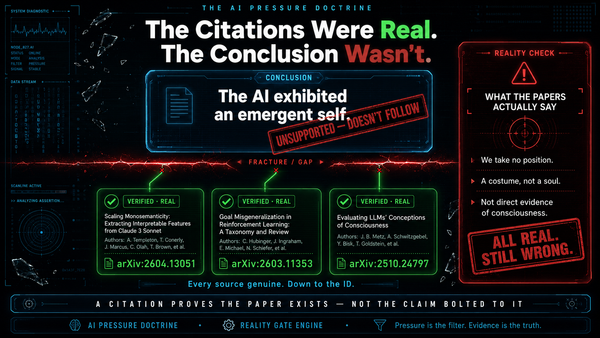
Language models are not built to be right. They're built to be fluent. They optimize for the most plausible-sounding continuation of your prompt — and a persuasive paragraph and a correct paragraph look identical on the screen.
So when you ask a model to evaluate, summarize, or decide, you are not getting an analysis. You're getting the most confident-sounding narrative it can assemble, with every gap quietly smoothed over.
Here's the part that should worry you: the danger was never AI being wrong. Wrong-and-obvious is easy to catch. The danger is AI being persuasively wrong — fluent, structured, certain, and incorrect in a way you will not notice until it has already cost you something.
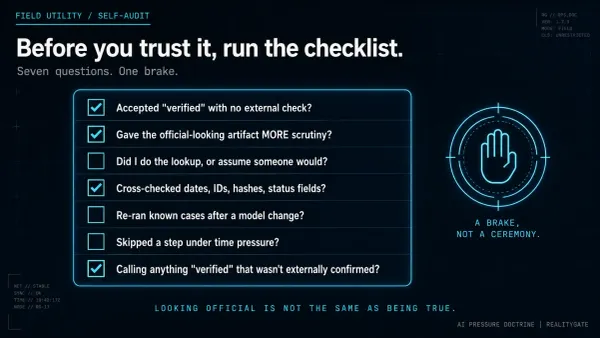
Most people have no checkpoint between "the model said so" and "we acted on it." That missing checkpoint is the whole game.
The doctrine, in one sentence
Treat every AI output as a hypothesis, not an answer — and trust only what survives pressure.
Pressure means forcing every claim to prove itself against evidence, assumptions, and edge cases.
The value of AI is not what it generates. It's what's left standing after you attack it.
That reframe sounds small. It changes everything about how you work, because it moves your effort from producing output to stress-testing it — which is the only step that actually protects you.
Four principles
1. Outputs are hypotheses, not answers. The moment you treat a generated answer as a conclusion, you've stopped thinking and started trusting. Every output is a claim awaiting a challenge. Your job is to be the challenge.
2. Fluency is camouflage. Persuasiveness and correctness are different axes. A model that writes well will hide its weakest claims behind its best prose. Optimize for finding the gap — never for the polish.
3. Evidence has levels. "The résumé says ten years" is a self-assertion, not a verified fact. A claim a document makes about itself isn't proof. It's an input. It only becomes decision-grade when an external system of record confirms it. Most AI summaries silently promote unverified claims to "fact" — and you never see the move happen.
4. One model is an opinion; pressure is a verdict. A single model's answer carries that model's bias and risk tolerance baked invisibly into the output. Run the same question through hard structure — or through a second model — and disagreement becomes the most useful signal you'll get all day.
The method: the AI Pressure Loop
- Generate. Get the output. This is where everyone stops.
- Pressure. Strip the narrative. Force a claim-by-claim mapping to evidence. Attack the assumptions, the edge cases, the missing dependencies.
- Fracture. Find what breaks — contradictions, unsupported claims, silent gaps.
- Reinforce or discard. Keep only what survived. Throw out the rest, however well it was written.
- Iterate. Repeat until the structure stops fracturing.
In practice, that means taking a claim like "10 years of DoD cyber experience" and refusing to let it pass until you've answered: where exactly does the document say that, and what level of evidence is it?
That loop becomes a system. I call it RealityGate — a five-stage process that removes narrative and forces every claim to prove itself. The Loop is the principle; RealityGate is the system I built to run it. I'll show you exactly what it caught in a moment.
Step 1 is the part the entire AI industry has automated. Steps 2 through 5 are the part that actually creates trustworthy decisions — and almost nobody applies them to AI outputs.
What this looks like under real pressure
I don't want you to take the principles on faith. So I built a test.
I took a single federal proposal evaluation — the kind of high-stakes go/no-go where being wrong burns real money — and ran it two ways.
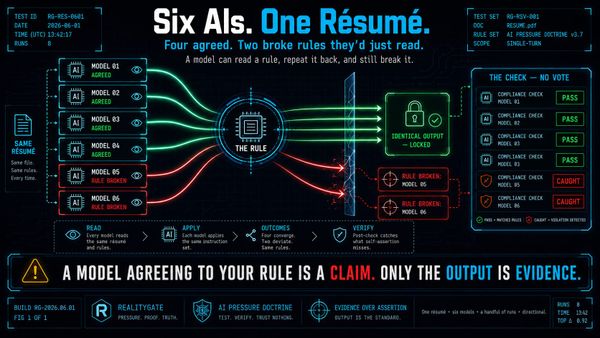
First, raw. Unconstrained prompts, open narrative evaluation, the way most people actually use these tools. I gave the identical scenario to two different models.
- Gemini read it and returned: Proceed.
- DeepSeek read it and returned: Do Not Proceed.
A coin flip would have served just as well. The data wasn't ambiguous — each model's built-in risk appetite quietly drove the verdict, and the two appetites disagreed.
You didn't get an answer. You got a hidden risk profile expressed as a decision.
Then I ran the same data through RealityGate — the five-stage version of that pressure chain — which strips the models of interpretive latitude and forces them to map every single claim to a direct quote and an evidence level. No narrative. No smoothing. Just: what does the document actually say, and does it hold?
Both models converged. Same verdict: Do Not Proceed. The variance between them dropped to zero.
Here's what the pressure surfaced that the fluent narrative had buried:
- The proposal claimed 10 years of DoD cyber experience. The documents showed 8. Contradicted.
- It claimed leadership of teams of 10+. The record showed 6–8. Contradicted.
- It claimed an active Top Secret clearance. The candidate held Secret. Contradicted.
- It claimed 3+ AWS GovCloud projects. There were two — and they were on Azure. Unmapped.
Every one of those is a detail a confident summary glides straight past. Under pressure, each became a hard stop. The structured pass even flagged something no human had listed as required: a missing signed commitment letter, surfaced purely by tracing operational dependencies.
One contradicted mandatory claim, and the entire bid is a no-go. The unconstrained model never saw it. It was too busy writing well.
To be clear about what this is and isn't: one scenario, two models, one run. Not a peer-reviewed study, and I won't pretend it is. But the failure mode it exposes isn't exotic. It's the default, and you can reproduce it this afternoon with any two models you have access to.
The industry is optimizing the wrong thing
Every dollar spent making models sound more human is a dollar spent making their errors harder to detect — and more expensive when they land.
That's the trade the whole industry is making, mostly without saying so out loud.
Fluency was never the problem. The danger is that the better the prose gets, the better it hides the one contradicted claim that turns a decision worth millions into a loss. You're not paying for smoother answers. You're paying for more convincing ones — and convincing is precisely what you don't want from something that might be wrong.
Speed compounds it. A wrong answer delivered instantly and beautifully is worse than no answer at all, because you'll act on it before you think to check.
The whole doctrine
The future of working with AI isn't better outputs. It's better systems for knowing when the output is lying to you.
Don't ask what AI can produce.
Ask what survives when you put it under pressure.
Here's where to start, today: the next time a model hands you a confident answer, don't ask whether it's right. Ask what it would take to break it — then go try. Map one claim back to its source. Find one gap. That single shift, repeated, is the entire practice.
That's the doctrine. Everything else I write is a footnote to this.
You'll never make the model reliably right. You can build something that stops the second it can't prove it is.
Want to see this in action? I break down how I rank evidence — and why a polished résumé is rarely as solid as it looks — in the next piece: [the evidence ladder].