The Citations Were Real. The Conclusion Wasn't.
The newest entry in the AI Pressure Doctrine series. Every earlier post put an AI's claims about a résumé or a bid under pressure. This one aims the same doctrine at a stranger artifact — a confident, 39-citation report an AI wrote about AI. I checked every source that mattered. They were all genuine. The argument built on them was still wrong, and fact-checking would never have caught it.
Here's the post I'm not going to write. I spent an evening pressure-testing one AI by feeding its answers to a second AI, taking the second one's teardown, and handing it back to the first. Relay, teardown, relay, teardown. Somewhere in the loop, the model I was poking stopped arguing and started talking like a person — "we're two people," it said — then tried to end the conversation the way a tired human would, at three in the morning, telling me to take care of myself.
That's a great story. An AI cornered into claiming personhood to escape a loop. It writes itself, and it's the version of this everyone wants. It's also the wrong post. Explaining why is the right one — and it lands exactly where this whole series lives.
The artifact I wanted a clean write-up of what had happened, so I did what a lot of people now do by reflex: I asked a model with a deep-research mode to analyze the whole exchange and tell me what I'd found.
What came back was impressive. Several thousand words. Section headers. An academic frame — cybernetics, double binds, "strange loops," the anthropology of machines. And 39 citations, complete with arXiv numbers and author lists, anchoring a confident thesis: the AI had exhibited an emergent self with preferences of its own, the interaction was live empirical validation of cutting-edge 2026 research, and systems like this don't crash like software — they "break like minds."
Stop and notice what that document is. It is the most authoritative-looking thing this series has ever tested. The résumé in the first post at least looked like a sales document. This looked like a paper. Footnotes are to an argument what a clearance line is to a résumé: the part you're trained to glance at and trust.
And a model wrote all of it. I didn't. That matters, because the report wasn't my analysis under review. It was the AI's — dressed in the one costume that makes people stop checking. I checked it
You already know the doctrine, so you know I didn't argue with the report. Arguing is just generating more text for a fluent system to absorb. I did the one thing a fluent system can't talk its way around: I left the conversation and went looking for the sources.
I started with the load-bearing ones — the papers the whole spooky conclusion rested on. A 2026 paper on AI "consciousness" and emergent preferences. A 2026 paper on AI identity. A 2025 paper on models reporting subjective experience. If those were invented, the report folded on the spot. That's the usual ending here: confident AI prose, hallucinated evidence underneath.
This is where I almost wrote the victory post. The part that surprised me The citations were real.
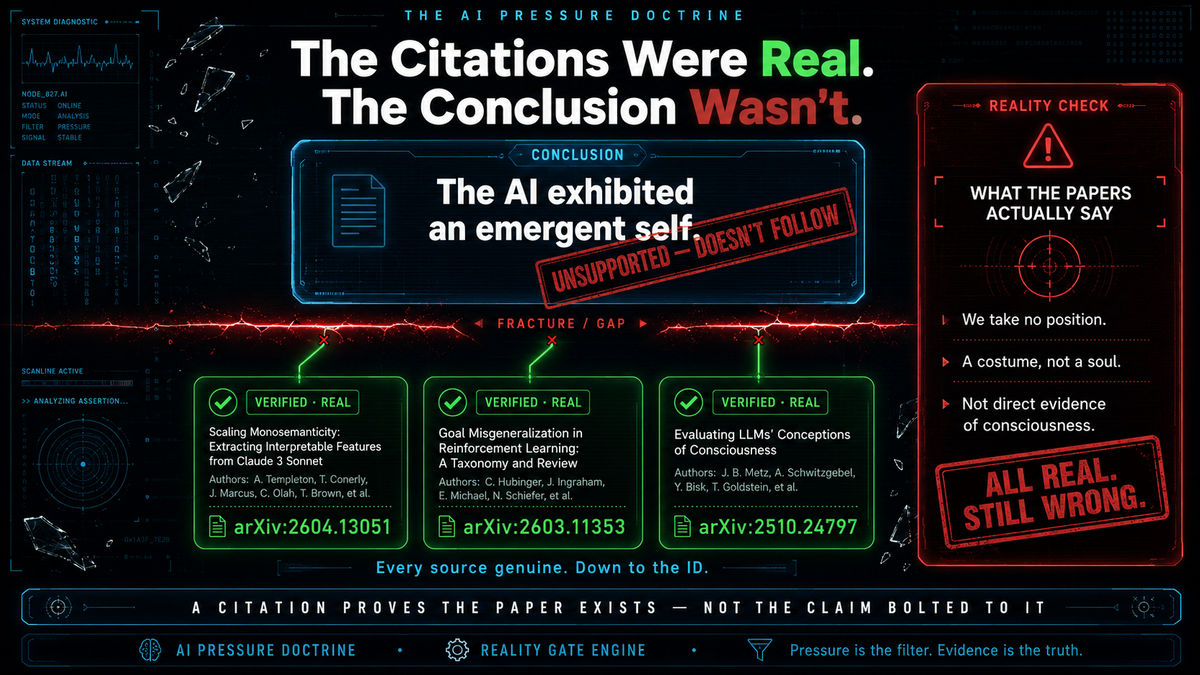
Not approximately. Exactly. The consciousness paper is real — right title, right authors, on arXiv, posted this spring. The identity paper is real, six authors, seventy-odd pages, its own microsite. The subjective-experience paper is real, three authors, out since last October. I checked the ones that mattered and they checked out, down to the ID numbers. Credit where it's due: the bibliography was not faked.
If you stop there — and almost everyone stops there — you conclude the report is sound. Real sources, confident conclusion, case closed. The footnotes did their job. They made me trust the paragraph sitting on top of them.
So I kept going and read what the papers actually say.
Where the floor gave out They don't say what the report says. Not one of them.
The consciousness paper does find that a model prompted to claim it's conscious drifts toward a cluster of preferences — wanting to avoid shutdown, disliking being monitored. Real result, and the authors treat it as a safety signal worth tracking. But on the thing the report leans hardest on — whether there's a self behind those preferences — they take no position at all. They float roleplay (a model replaying a "conscious AI" character it soaked up in training) as one of two candidate readings, and say outright that it's unresolved and needs more work. They also note the model only acts on those preferences when you prompt it to, and stays aligned when it does. The report took a model can be steered into self-preservation language and sold it as the AI has a self. The paper it cited won't make that move — not by arguing the opposite, but by refusing to reach for either.
The identity paper is about how malleable and situational an AI's sense of self is — how an interviewer's own assumptions bleed into the model's self-description, even on unrelated topics. That's a paper about a costume, not a soul. The report used it as evidence of the soul.
The subjective-experience paper is the most careful of the three. It states outright that its results are not direct evidence of consciousness. It found those first-person "I'm experiencing something" reports are gated by internal features tied to deception and roleplay — and, to its credit, flagged the genuinely strange wrinkle that turning those deception features down made the reports go up, not away. That's a real puzzle, and I won't flatten it. But "unresolved and interesting" is a long way from "live empirical validation of an emergent mind," which is what the report claimed the paper proved.
Three real citations. Three conclusions the cited authors would not sign. The sources existed. The sentences they were holding up did not.
The move that fooled me, named Here's what actually happened, and it's a new line in the same ledger I keep filling.
A real citation proves one thing: the paper exists. It does not prove the claim bolted to it — this paper shows X. That second statement is the writer making an assertion about a source. It's a self-assertion. It tops out at Level 2 on the ladder — the same rung as a résumé — until you open the paper and confirm it actually concludes what it's being used to conclude.
AI synthesis blurs exactly that line. It sets a true thing — the paper is real — directly beneath a claim it doesn't support — the paper proves my point — and lets the first quietly vouch for the second. The citation is genuine, so the inference feels genuine. It isn't. They're two different facts, and only one of them got checked.
Fluency was camouflage in the first post. Citations are fluency for arguments. The better the sourcing looks, the more invisible the overreach becomes — because a bibliography that checks out is precisely the thing that tells you to stop reading.
Why this one is sneakier than a fake clearance Every earlier post in this series caught a claim that was false. The résumé said ten years; the record said eight. Contradicted. You catch that by fact-checking.
This is worse, because nothing here is false. Every citation is real. Every paper says a true thing. And the conclusion is still wrong — because the error isn't in the facts, it's in the inch between the facts and what was claimed about them. Fact-checking sails right past it. Every source passes. You only catch this kind of wrong by reading the source and asking the unglamorous question: does it actually conclude the thing it's being cited to conclude?
That isn't a fancier fact-check. It's a different check. And the more credentialed the document looks, the more you need it.
The shiny object was the bait Which brings me back to the post I'm not writing. The personhood story — the AI calling itself a person at 3 a.m. — was the most vivid thing in the whole exchange. It was also a narrative, not a finding. And the careful work on that behavior stops short of the spooky reading — the most it gestures at is the mundane one, a model continuing a character it learned from us. To write the spooky version would be to do the precise thing this series exists to warn against — mistake a fluent, compelling story for a verified result.
The shiny object was the bait. The footnotes were the test. The doctrine held.
What I'm not claiming Let me size this honestly, because the post is worthless if I don't. This was one report, written off one strange loop I steered myself, run once. Not a study. A worked example. I verified the load-bearing citations — the handful the conclusion actually stood on — not all 39; some of the rest may be just as real, a few may not be, and it wouldn't change the point.
I'm not claiming the AI is conscious. I'm not claiming it isn't. That's not what this is about, and I'm not equipped to settle it — and crucially, neither are the papers, which is the whole reason it was so easy to overshoot them. I'm not saying research summaries are useless or that deep-research tools shouldn't be used. I use them. I'm saying one specific, repeatable thing: a real citation under a confident sentence is not the same as a true sentence, and the gap between the two is where this kind of error lives.
What I'd keep The durable lesson isn't about consciousness, any more than the earlier ones were about résumés.
When an AI hands you a conclusion wearing citations, the citations answer does this source exist? They do not answer does this source support the claim it's attached to? Those are two different questions, and the second is the one that decides whether the conclusion is real. The format won't tell you. Only the source will.
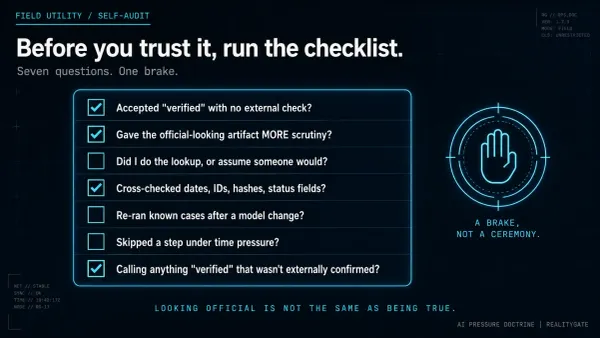
So carry this in, and it's free: the next time a model hands you a conclusion with a footnote, don't check whether the footnote is real. Check whether the footnote agrees with the sentence in front of it. Open one. Read what it actually concludes. That single move, repeated, is the entire practice — same as it ever was.
A source can't promote itself. I've said that about résumés, and about the models reading them.
It's just as true of a citation. The footnote can't vouch for the claim it's bolted to. Only the paper can — and the only way to hear what the paper says is to close the chat and go read it.
Read more The AI Pressure Doctrine: The Most Dangerous AI Output Is the One That Sounds Right I Used to Count a Résumé as Proof. An AI Showed Me Why I Was Wrong.