The RealityGate Self-Audit: 7 Questions Before You Trust an AI-Assisted Review
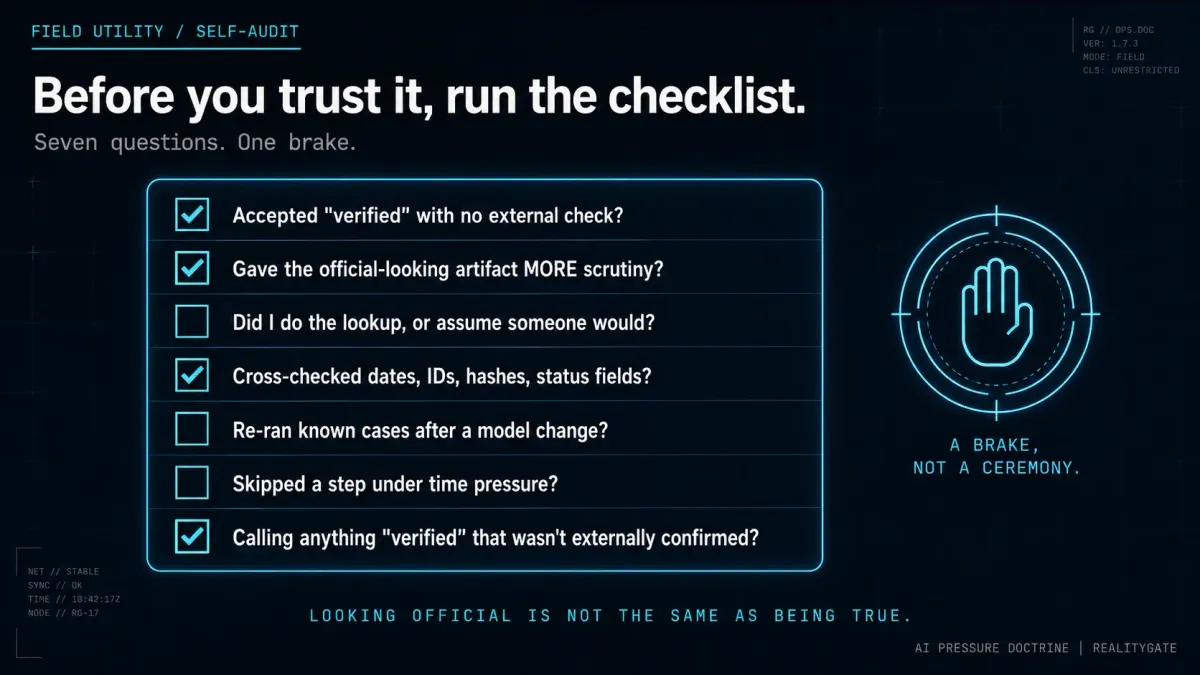
Looking official is not the same as being true. The model grades the polish. You verify the fact.
A short utility from the AI Pressure Doctrine series. Not an essay — a tool. Copy it, keep it, run it.
Most AI failures do not announce themselves as nonsense. They arrive as fluent summaries, clean verdicts, confident labels, and official-looking artifacts that seem already settled. That is where the risk lives.
Use this checklist at the end of any AI-assisted evidence review — before you act on the output, sign off, or pass it up the chain. It matters most when the result affects a real decision: a compliance position, a hiring judgment, a proposal call, an audit finding, or a security conclusion.
Do not treat it as ceremony. Treat it as a brake. Copy it into your review notes. Answer it before you move on.
Self-Audit — Reviewing AI-Assisted Evidence
Did I accept any "verified," "compliant," or "passed" from the model without an external check? [Yes / No]
Which artifact looked most official today — and did I give it more scrutiny, or less? [One sentence]
For every claim that required an external lookup: did I personally execute the lookup, or assume someone else would? [Y / N per claim]
Did any artifact contain dates, IDs, tiers, case numbers, hashes, signatures, or status fields I did not explicitly cross-check? [List them]
If I changed models or versions today, did I re-run a known case set? [Yes / No / N/A]
Was there a moment I felt pressure to move faster — and did I skip a step because of it? [One sentence]
Am I calling anything "verified" or settled that has not actually survived an objective external check? [Yes / No — explain if yes]
How to Use It
Run the checklist at the end of the review, not the beginning. The point is to catch the places where confidence quietly outran evidence — and those only become visible once the work is done.
A model can help you triage, summarize, extract, compare, and flag. It cannot turn internal consistency into external truth. That last step is yours. The rule is simple: Looking official is not the same as being true. The model grades the polish. You verify the fact.